Alligator cracks across the drive, crumbling edges, a low spot still holding water three days after the rain.
Asphalt paving in this town is a wrestling match with ground that never holds still, and most of what goes wrong starts under the surface rather than on top of it.
We're asphalt paving contractors doing driveway paving, church lots and short stretches of private road across greater New Orleans, and a good share of what we get called out to look at is somebody else's fresh mat laid straight over a soft base that pumps water. Sold cheap, cracked by the next parade season. We dig that out instead of hiding it.
What decides the size of your job is the square footage, how the truck gets in, how far down the bad base goes, and the stretch of the year we're working in.
Further down I get into how the work is really done, what it runs, when patching beats repaving, and the things folks ask me first. Ring me at (504) 607-7395 and I will come stand on it with you.
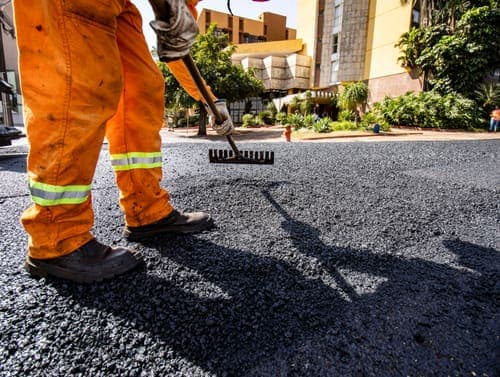
Hot Mix Asphalt
Hot mix asphalt is exactly what the name says. It leaves the plant somewhere north of 300 degrees, and from the second that truck tarps up, we're racing the thermometer. Get it down while it's hot, roll it while it's hot, or you've got a mat that never knits together and starts raveling into loose stone by the second summer.
That's why timing matters more than muscle on these jobs. We want the mix laid and compacted before it drops under about 185 degrees, which in January means early trucks and tight scheduling, and in July means keeping an eye on those 3 o'clock thunderstorms that show up like clockwork off the river. Rain on fresh mix is a redo, not a repair.
Most residential work here goes down as a two inch compacted surface course over a properly rolled base. Commercial lots usually want a binder lift underneath it.
Plenty of paving contractors will lay hot mix asphalt in a hurry. The rolling pattern behind the paver is where the difference actually lives.
Asphalt Sealing
Sealer isn't paint, though plenty of folks treat it like it is. It's a thin coat of asphalt emulsion that keeps UV and standing water out of the binder holding your stone together. Skip it and the surface goes gray, then brittle, then it ravels into loose grit you'll track across the kitchen floor.
The order matters. Sweep it clean, prime the oil spots so the sealer actually sticks, fill every crack wider than a pencil with hot rubberized sealant, then lay two thin coats instead of one fat one. Thick coats peel. Fresh asphalt paving wants six months to a year of curing before its first seal, and after that, every two to three years in this sun.
Then we watch the radar. Asphalt sealing needs about 24 dry hours, and a July storm off the lake doesn't negotiate.
Roads Paving
Roads paving is a different job from a home drive: private subdivision streets, the loop through an apartment complex, the service road behind a warehouse where delivery trucks and garbage rigs turn all day. That weight is why we lay these thicker than driveway paving and why the stone base gets most of our attention before a single load of asphalt shows up.
We crown the center and pitch the edges so rain sheds off instead of sitting on the shoulder and softening the ground underneath, which in this soil is already doing its best to sink on you.
Get that wrong and you see it inside a year: ruts down the wheel paths, edges raveling into the grass, standing water after every afternoon storm.
Length, access, how deep we cut, and whether we can keep a lane open all move the price.
What the job involves
Most of the work happens before a drop of asphalt shows up.
We cut and haul out whatever is failing, then look at what's underneath, which in Gentilly or Lakeview is usually soft clay that holds water like a soup bowl. That's the part cheap paving companies skip. We grade for drainage first, get the slope running away from your slab and toward the street or a drain, then lay and compact limestone base in lifts. Compaction is the whole ballgame.
Skip it and you get birdbaths and alligator cracking inside two summers, no matter how pretty the surface looked in June.
Then the paving itself: tack coat on any existing edges, mat laid at a consistent depth, rolled hot while it's still workable. A residential drive is usually a one day job, a parking lot runs two or three depending on size and phasing.
Stay off it for a day or so, longer in August heat, and keep the pickup truck's wheels rolling instead of cranked in place for the first few weeks.
What it costs
What it costs comes down to five things, and not one of them is guessable from the curb: how big the area is, whether a truck can get to it, how deep we have to go, the shape the old surface is in, and what the soil underneath is doing.
A narrow drive behind a raised shotgun house with a side gate means hand work and small machines, which runs higher than an open lot a paver can roll straight down. Depth moves it too, since a residence and a route carrying delivery trucks don't get the same section of asphalt.
Call me at (504) 607-7395 and I'll measure the real thing. Plenty of asphalt companies price straight off square footage, but the condition of the base decides whether this is a resurface or a rebuild, and those are not close to the same number.
When asphalt paving is the wrong fix
Asphalt paving is the wrong fix more often than you'd guess, and I want to say so before a truck rolls out. If your drive is solid and you've got one sunken spot by the mailbox, that's asphalt patching, half a day, not a new surface. Fine cracks that haven't opened up yet want asphalt crack filling and nothing else.
Surface gone gray and rough, but nothing rocks or sinks when you drive it? Resurfacing driveway over the old mat gets you there for less, and it holds.
Where new pavement really fails is water. Lay it over a soft, wet base and it'll alligator and dish within a season, and then you've paid twice. Same with a low corner that ponds after every rain. That's drainage and full-depth asphalt repair first, and sometimes just spot asphalt driveway repair after.
Why choose us for this
You have a driveway or a lot that has gone soft at the edges, and what you want out of asphalt paving is to hire somebody once and stop thinking about it for years. Not to supervise. Not to hear one number on the phone Tuesday and a bigger one on the invoice Friday.
So, a fact about the work instead of a promise about me. Plenty of paving contractors will quote you a thin lift laid straight over whatever is failing underneath, because it looks sharp until the first hard summer of rain and the callback is not their problem. I will not pave over a base that is holding water. It comes out first.
My number often sits above the other asphalt companies you talked to, and depth is the reason. Size, access and how far gone the surface is move it too. Measuring it costs you nothing and books you into nothing.
Frequently asked questions
Will 2 inches of asphalt hold up on a driveway?
For cars, yes, provided that 2 inches of hot mix asphalt sits on 6 to 8 inches of well compacted stone. Park a work truck or haul a boat trailer over it and I'd rather lay 3. Our ground moves down here, so the base does more of the work than the black you can see.
Can you patch my driveway instead of repaving the whole thing?
Often, yes. If the cracks run top down and the surface still feels firm underfoot, we saw cut the bad section, rebuild the base and tie it back in. But that spiderweb pattern folks call alligator cracking means the base is finished, and patching over it buys you one wet season, maybe two. Once about a third of the drive looks like that, repaving is the honest call.
How do we get started?
Call us and we'll come out and measure the drive, check how the water leaves it, and talk through the paving plan. We work 9 to 5, Monday through Friday, plus Saturdays when a job truly can't wait.
Contact New Orleans Asphalt Paving now
Ready to get a start date on asphalt paving in New Orleans? Dial (504) 607-7395 and one of us will come out, walk the driveway or the lot with you, and pull real measurements instead of guessing off a satellite photo the way some paving companies do.
Tell me on the call about how big the area is, whether trucks run over it, whether water still stands on it a day after a rain, and whether the edges have broken down along the sides. Those four answers set the depth and the prep, and prep is most of the job.
Driveway paving, parking lots and roads paving all come off the same crew. If what you actually need is asphalt sealing and a couple of repairs, say so and nobody here will push a whole new surface at you. Somebody's in through the working week, nine to five, and messages get called back.